

Programmable Nanomaterials
The ability to synthesize materials by design is one of the greatest outstanding scientific challenges. Advances towards meeting this challenge will lead to discoveries in fields such as plasmonics, photonics, catalysis, and energy sciences.
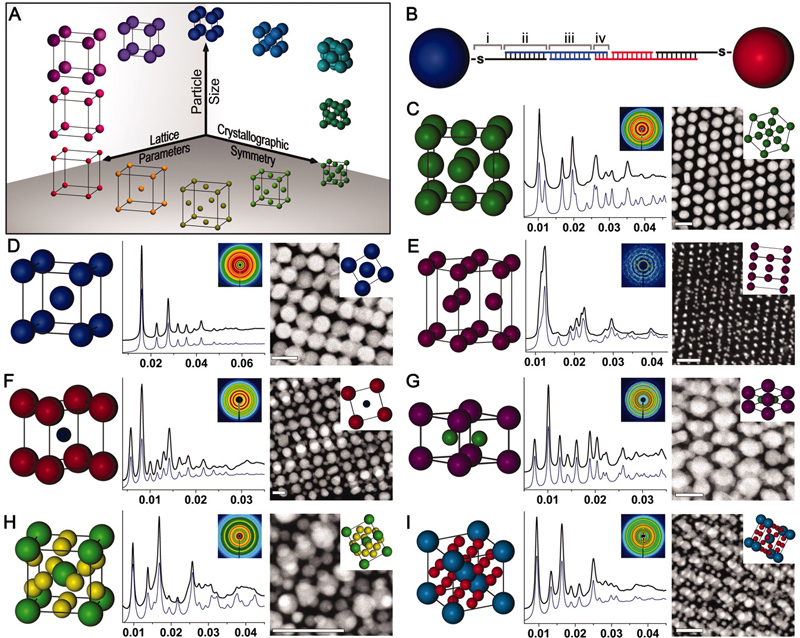
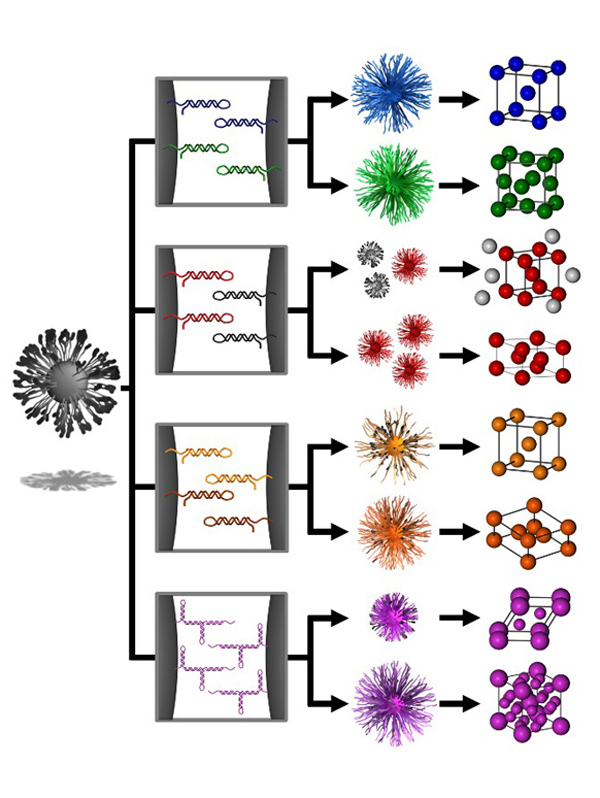
In the Mirkin group, we employ a novel approach to the realization of materials by design, where nanoparticle “atoms” functionalized with a dense shell of oligonucleotides are assembled via oligonucleotide “bonds” into crystalline superlattices with tunable compositions, symmetries, and lattice parameters. The high degree of control over the assembly characteristics of these oligonucleotide-nanoparticle conjugates, termed “programmable atom equivalents” (PAEs), is enabled by the exceptional molecular recognition, tunability, and predictability of the nucleic acid bonds (Fig. 1). Unlike atomic systems in which the bonding character of an atom is dictated by its atomic composition and configuration of valence electrons, PAEs allow one to independently control the nanoparticle core (tunability in the nanoparticle size, shape, or composition) separately from the oligonucleotide “bonds” (controllable nucleic acid type, sequence, length, flexibility, and strength).
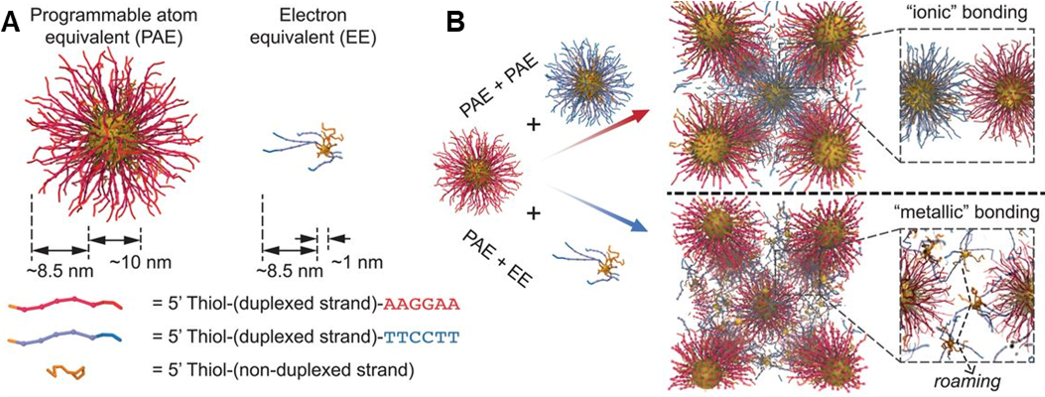
While PAEs provide discrete control over crystal engineering where the location of every nanoparticle is fixed, we discovered that small nanoparticles (~1.5 nm) functionalized with DNA can be mobile within nanoparticle lattices (Fig. 2). Specifically, these small particles, termed electron equivalents (EEs), readily diffuse within stabilize lattices of repulsive PAEs. The diffusion (i.e., delocalization) of EEs introduces the concept of metallicity to colloidal crystal engineering, where metallic, intermetallic, and other complex phases can now be targeted. Ongoing research in the Programmable Nanomaterials subgroup focuses on exploiting the functionalities of the nanoparticle atoms in the crystalline state, tuning the nature of the DNA bonds, and studying the diffusive properties of small nanoparticles functionalized with DNA.
Integrating nanoparticle functionalities into superlattices
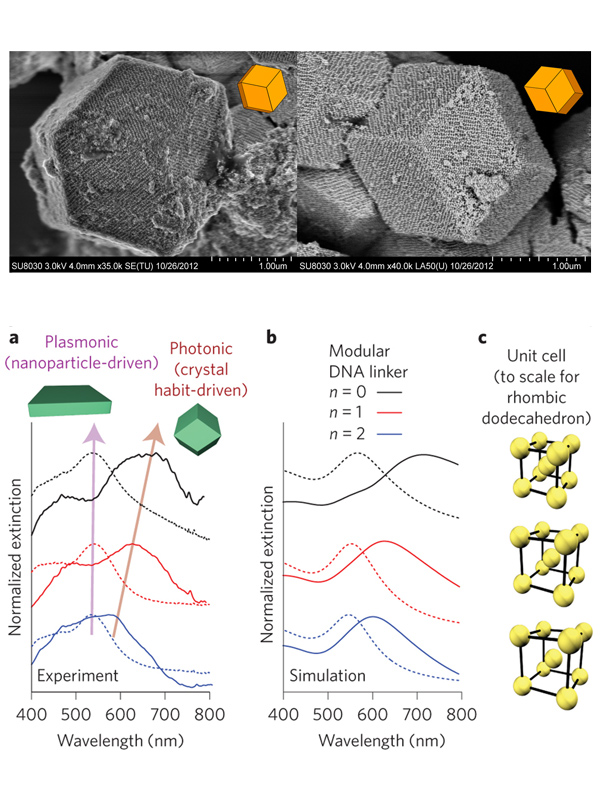
Nanoparticles have interesting catalytic and optical properties that are distinct from their atomic or molecular precursors and are often dependent on their assembly state. We are exploiting the programmability of the DNA bond to tune the structures of PAE superlattices assembled in solution or layer-by-layer on substrates and investigating how superlattice architecture influences light-matter interactions. Nanoparticle superlattices composed of Au nanoparticle-cored PAEs show strong light-plasmon interactions that were tunable by independently controlling lattice constants and nanoparticle diameters (Fig. 3). By employing a layer-by-layer assembly approach, the thickness of the crystal can be modulated to control the relative contributions of plasmonic and photonic properties to the overall light-matter interactions of the crystal. We are combining these experimental studies with a theoretical framework that will allow us to predict how crystal lattice structure, habit, and composition control light-matter interactions, and ultimately, allow us to develop highly tunable plasmonic metamaterials.
Utilizing the chemical addressability of proteins for DNA-directed assembly
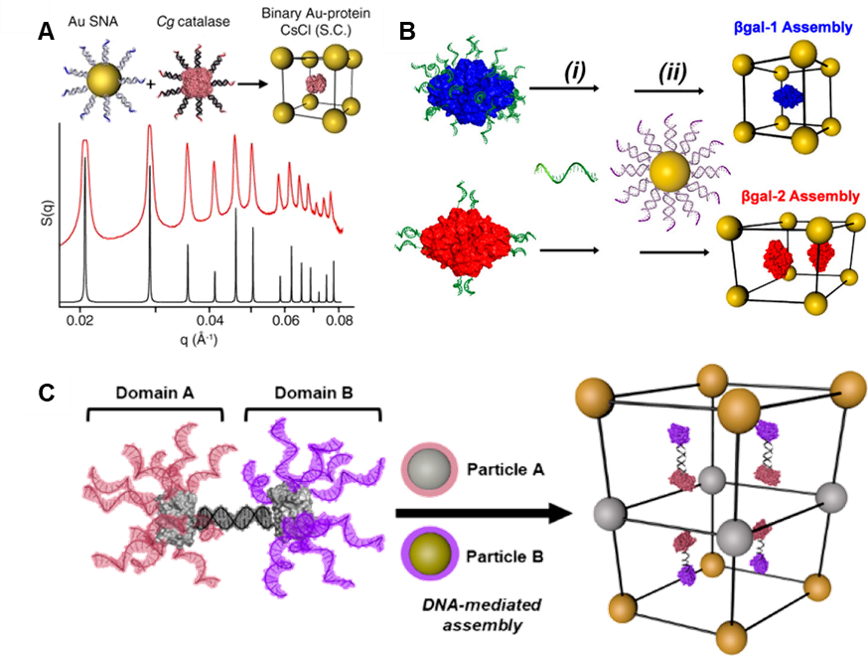
Proteins are archetypal nanoscale building blocks that assemble into functional materials with applications including catalysis, energy transfer, and structural actuation. However, programming the interactions between proteins, and their positions within materials, is challenging due to the various interactions which typify protein-protein interfaces. The Mirkin group is taking advantage of the diverse structures and the inherent or introduced orthogonal surface chemistries of proteins to control their assembly (Fig. 4) and develop polymeric protein systems, protein single crystals, and multicomponent superlattices with symmetries that are difficult to obtain using spherical PAEs. Ultimately, these protein-based materials will be designed to integrate the intrinsic functionalities of each protein building block selected into programmable hybrid materials (e.g., with inorganic nanoparticles).
Employing the programmability of the DNA bond to create tunable and responsive nanoparticle superlattices
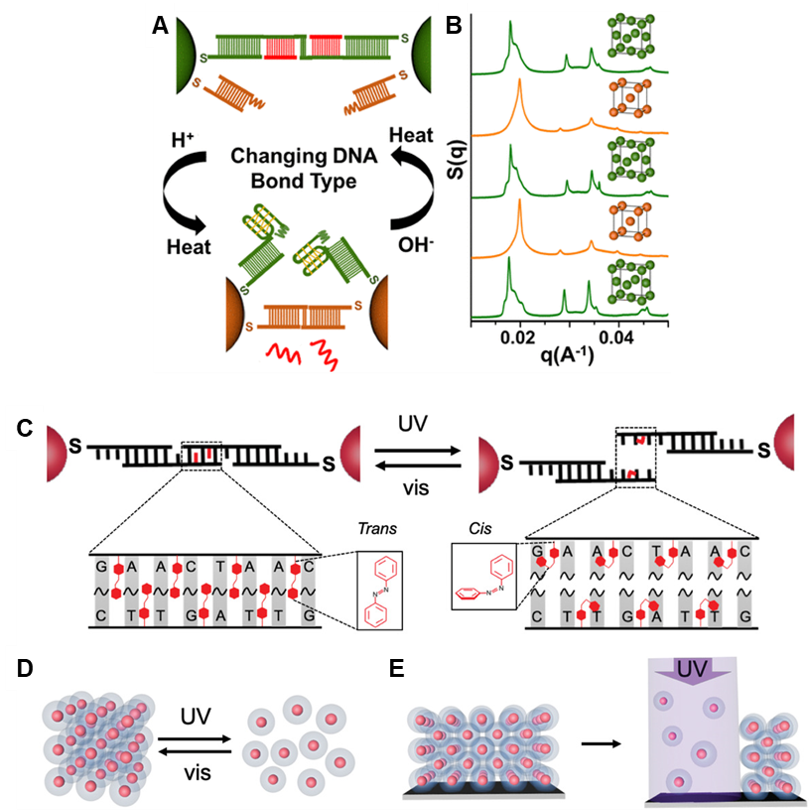
Biological systems are inherently responsive to external stimuli, enabling a high degree of control over complex processes such as signaling cascades. We are developing several unique approaches for designing oligonucleotide bonds that enable a similar degree of responsiveness and tunability to be incorporated into PAE superlattices. One example of this is the concept of “transmutable nanoparticles,” which include a number of closed ‘hairpin’ DNA strands along the surface of nanoparticles that cannot link with strands on neighboring particles (Fig. 5). The addition of “effector” strands, which are short oligonucleotide sequences that act as switches and can open these hairpins, allows the particles to bond into a particular lattice arrangement. By using different switches and combinations of nanoparticles, we can effectively and dynamically change the bonding character of “transmutable nanoparticles” and drive their crystallization pathway along multiple thermodynamic trajectories.
Programmable Materials Subgroup Members
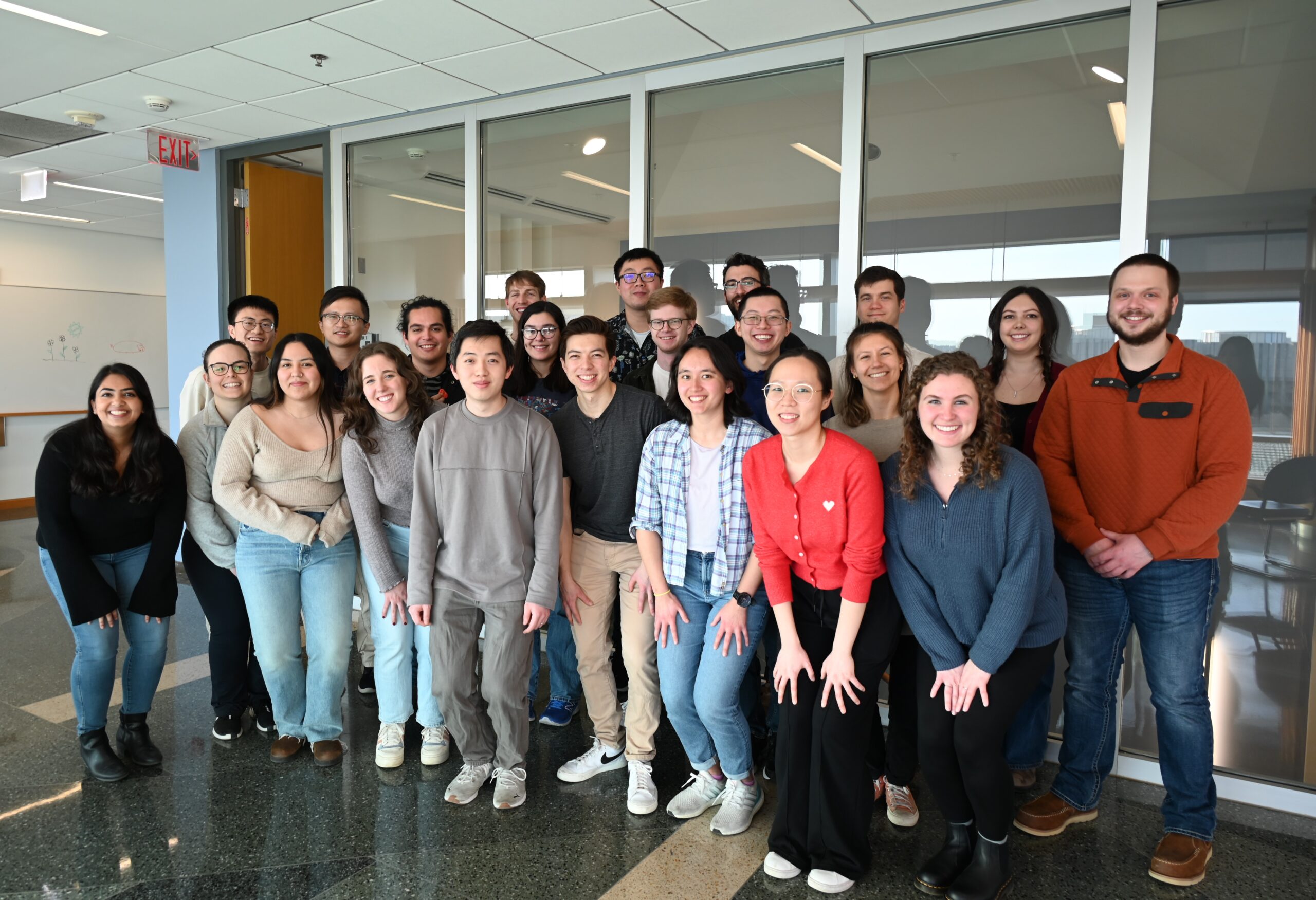
Middle row (L-R): Xiaowei Liu, Jun Li, T. Ocampo, Maya Kesan, Jack Ahrens, , Allen Guo, Rachel Chan, Mia Pascall, Tanner Fink (subgroup leader)
Front Row (L-R): Namrata Ramani (Subgroup leader), Ana Leal, Jennifer Delgado, Hadley McCormick, Yinglin Ma, Alex Cushing, Janice Kang, Julianna Burgeois